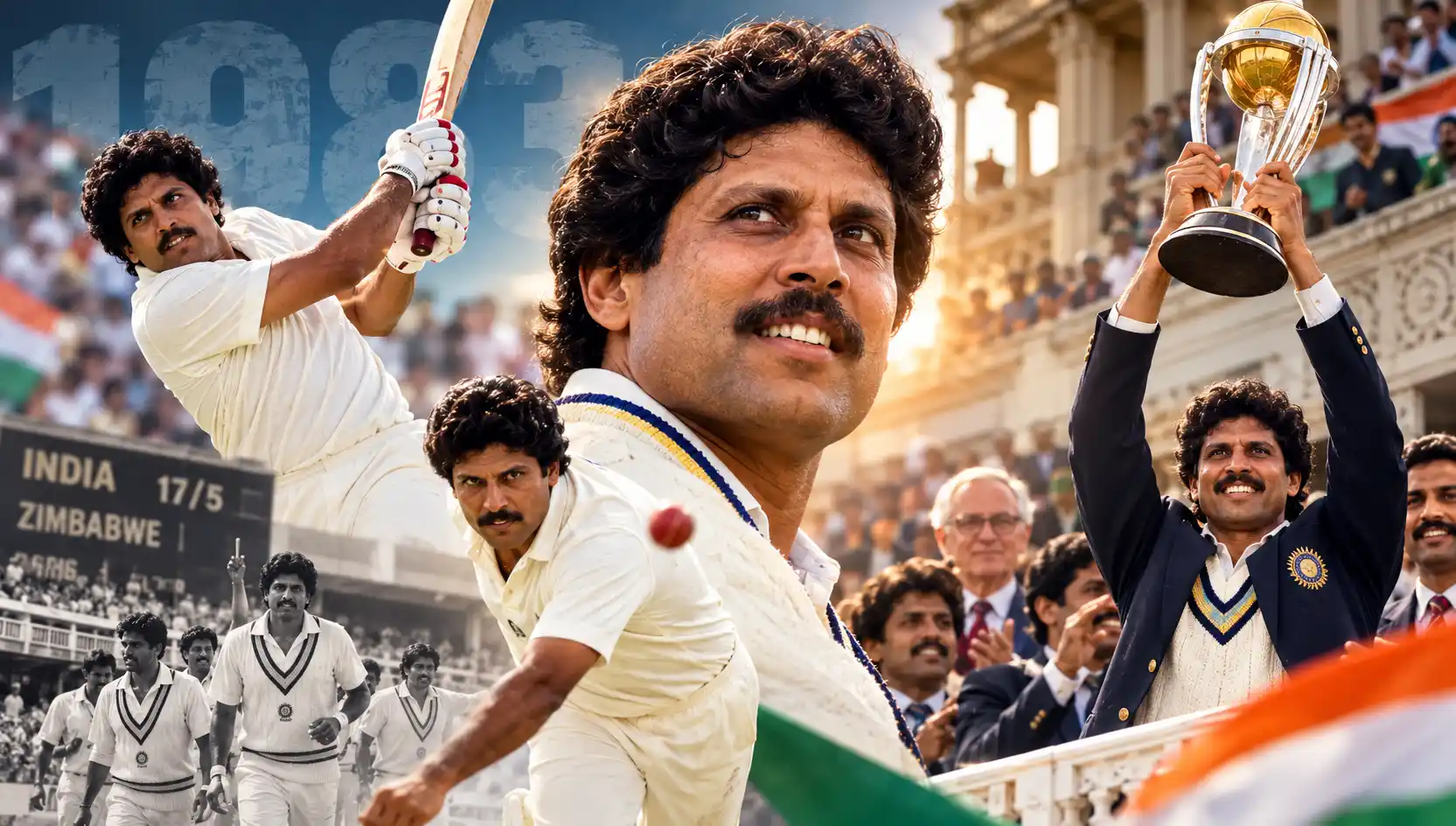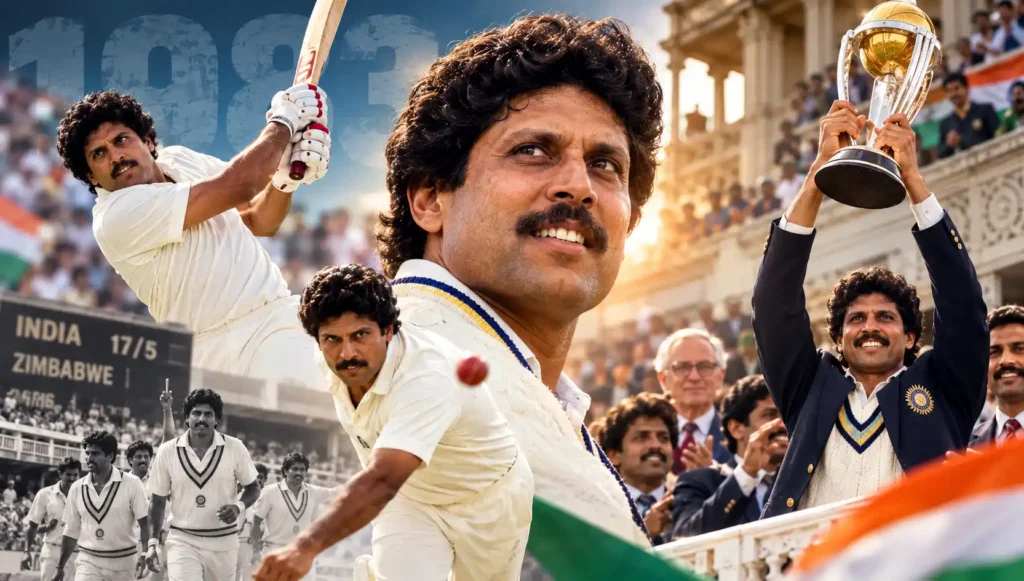
Seventeen runs for five wickets down on a damp English morning at Tunbridge Wells. Neville Cardus could never have scripted a grimmer start for Indian cricket.
June 18, 1983. The West Indies speed merchants owned every newspaper headline. Cricket experts gave India zero chance of surviving the group rounds.
Then our twenty four year old captain grabbed his pads and walked straight out onto the turf.
Three hours later, he walked back with an unbeaten 175 against Zimbabwe. That single innings turned the entire tournament upside down. Most Khelofun readers know the final score by heart, yet few understand how close our country came to an embarrassing early exit that summer.
When fans discuss Kapil Dev cricket records, his career meant way more than one great afternoon in Kent. We are talking 434 Test wickets, over 5,000 Test runs, and hoisting the World Cup trophy on the Lord’s balcony.
So, what truly matters most to fans today? Was it his relentless workload as a frontline seamer, that miraculous rescue at Tunbridge Wells, or his fearless leadership? Let us look at the facts.
Player Profile Summary
- Full Name Kapil Dev Nikhanj
- Born January 6, 1959 (Age 67 years as of October 2026)
- Birthplace Chandigarh, India
- Role Right-hand middle-order batter and right-arm fast-medium bowler
- International Career 1978 to 1994
- Captaincy Peak Winning the 1983 Men’s Cricket World Cup
From Chandigarh Streets to Fast Bowling Glory
Being a kid from Chandigarh in the sixties, Kapil Dev Nikhanj had no facilities of indoor training centers or video analysis experts around him. All he did was run hard on dry dirt pitches, motivated by his desire to be faster than everyone else in northern India.
Indian cricket relied almost entirely on spin back then. Captains routinely opened bowling spells with part-time medium pacers just to take the shine off the red ball before handing it over to the spinners.
Kapil smashed that routine to pieces against Pakistan in October 1978. He charged in all day long, hurling quick outswingers that rattled pads and terrified experienced opening batters.
Why All Round Skill Changed Everything
Specialist batters score runs. Specialist bowlers hunt wickets. True all-rounders do both and give a captain tactical freedom.
The presence of a frontline fast bowler that walked in as sixth man and scored match-winning hundreds made India very flexible. This combination is the reason why Kapil Dev cricket records stand out as the benchmark when legends are compared across eras.
Opposing captains could never relax after breaking through the top order because Kapil routinely converted modest totals into winning scores within forty minutes.
The Tunbridge Wells Miracle Without Television Cameras
A sudden strike by the BBC on June 18, 1983, ensured that not even one television camera captured the game against Zimbabwe. Millions of supporters back home were dependent only on radio commentaries and morning papers.
Key Score Highlights from Tunbridge Wells
- Team Situation at Entry 17 runs for 5 wickets on a green seam-friendly pitch
- Individual Score 175 not out off 138 balls
- Boundary Breakdown 16 fours and 6 massive sixes
- Key Partnership Unbroken 126 run stand with Syed Kirmani for the ninth wicket
- Match Outcome India reached 266 for 8 and defended it to prevail by 31 runs
That victory kept our World Cup dream alive. Without it, India packs bags early and catches an early flight home.
Analyzing all Kapil Dev cricket records shows that the missing television footage turned the knock into pure cricket folklore. Scorecards prove the numbers, but the lack of video footage makes the innings feel almost mythical to fans today.
Lifting the 1983 World Cup at Lord’s
Defending a 183 runs against West Indies on June 25, 1983, seemed impossible. West Indies had won the last two World Cup tournaments and were eager to secure their third consecutive world title.
Viv Richards was batting freely at 33 from 28 deliveries, pulling anything and everything with all his might.
Then Richards mistimed a hook shot off Madan Lal high into the London sky. Kapil turned his back, sprinted backward thirty yards, and grabbed a breathtaking tumbling catch over his shoulder. Richards walked off. The final shifted right there.
Team Effort & World Cup Victory
Leadership brought inspiration, but those historic 1983 World Cup achievements were a result of teamwork by an array of fighters.
Both Madan Lal and Mohinder Amarnath took three wickets each in the World Cup final, making it difficult for the opposition to make any run. Roger Binny ended up taking 18 wickets in the tournament and became Player of the Match in both the semi-final and final.
The leadership of Kapil inspired the team, but those 1983 World Cup achievements reflected the performance of his teammates that made a difference under pressure.
Test Match Numbers That Tell the Real Story
The fact that he was physically durable set him apart from most fast bowlers of his era. Below is the table summarizing all his career statistics.
International Career Overview Table
| Format | Matches | Runs Scored | Highest Score | Wickets Taken | 5 Wicket Hauls | Centuries |
| Test Cricket | 131 | 5,248 | 163 | 434 | 23 Times | 8 |
| ODI Cricket | 225 | 3,783 | 175 Not Out | 253 | 1 Time | 1 |
By retiring from international cricket in 1994 with a record 434 Test wickets, he became the highest wicket-taker among Indian Test bowlers of his era. Plus, he won that title by delivering thousands of grueling overs on flat pitches of the subcontinent without ever pleading for a breather.
Likewise, he is rightly proud of the title of being the highest wicket-taker of his era due to his combination of natural outswingers and superb physical fitness. He played 131 Tests without ever having missed a game due to an injury, a feat that modern-day fast bowlers can hardly even dream of.
Those studying historic cricket bowling records cannot ignore his 23 five-wicket hauls in Tests. Those studying cricket batting records can take note of his eight Test centuries, whereas those looking at overall cricket records know him as the first cricketer to have taken 400 Test wickets and scored 5,000 Test runs. Exploring these Kapil Dev cricket records proves his complete dominance with bat and ball.
Four Consecutive Sixes to Avoid the Follow On
During a tense Test match against England at Lord’s in 1990, India hovered near the follow on threshold with only tail-ender Narendra Hirwani left at the crease.
Twenty four runs were needed just to make England bat again. Kapil faced off-spinner Eddie Hemmings.
Instead of defending, Kapil launched four consecutive sixes straight over the mid-off and long-on boundaries. Twenty four runs in four balls. The follow on was cleared instantly, and Hirwani fell on the next delivery without scoring.
It was pure calculated aggression when danger knocked.
Life Beyond the Boundary and Personal Legacy
Kapil Dev turned 67 years old in October 2026. He married Romi Bhatia in 1980, and they share a daughter named Amiya Dev.
After retiring in 1994, he stayed deeply connected to sports, coaching the national squad in the late nineties and taking up competitive golf.
His journey offers a great lesson for young fans. True greatness comes from grinding out sixteen years of relentless work, not just enjoying one good week. He bowled over 27,000 overs in Test cricket alone while scoring over 5,000 runs.
Which Milestone Deserves the Most Credit?
Some fans will always pick the 175 at Tunbridge Wells because it saved a doomed World Cup campaign. Others point to his 434 Test wickets, a world record when he retired. For millions of Indian fans, seeing Kapil lift the World Cup trophy on the Lord’s balcony remains unmatched.
At Khelofun, we celebrate his story because every achievement shows a different side of his genius as a batter, bowler, and leader. Looking back at all Kapil Dev cricket records, his versatility remains inspiring to every sports enthusiast.
Which record means the most to you? Drop your thoughts in the comments below and share your favorite match memories with fellow fans!
Disclaimer: Independent fan tribute for informational purposes. Khelofun is not affiliated with Kapil Dev, the BCCI, or the ICC. Player records, trademarks, and data belong to their owners and are used under fair use. Career stats and age profiles are updated as of October 2026.